Showing posts with label UCI Sound. Show all posts

Tuesday, January 10, 2023

UCI Sound Design is Recruiting MFA students!

It's January, which means that UCI Sound Design is officially recruiting for our MFA class of 2026.  Have you been thinking about grad school for sound design, we want to hear from you!

If you think that a Sound Design MFA may be the next step in your career and/or creative life, we think you should give UCI a look.  We're proud of our program and the students who study with us, and we want to talk to you about what we can offer your education and whether we might be a good fit!

If you're interested in learning about UCI Sound Design, here's what you should do:
  1. email Prof. Vinnie Olivieri at olivieri@uci.edu to introduce yourself and set up a time to chat
  2. head over to our program website to read about the program.
  3. bookmark the application page for all UCI graduate admissions.
Drop us a line!  We'd love to chat with you!

And, for the algorithm, here are some photos of UCI MFAs doing awesome things in our program.


Students at Meow Wolf's Omega Mart on a field trip for their Themed Entertainment Class.
Kissing the duck brings good luck.


Walking from building to building on a tour of the Meyer Sound Lab facilities.


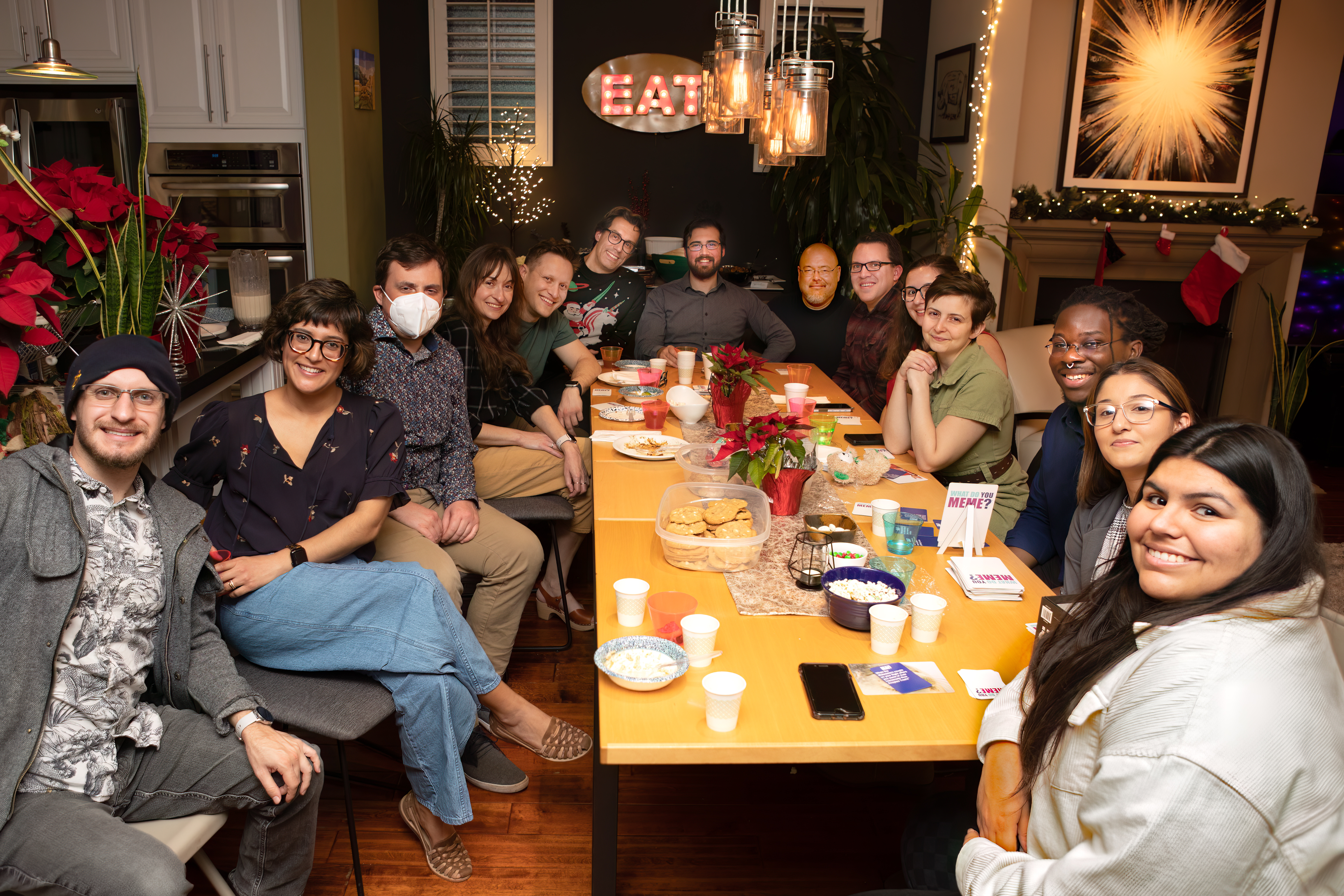
Students, alumni, faculty, staff, and a significant other at our annual Holiday Party!

Was the Escape Room trip part of Themed Entertainment research or team-building?  Why not both?

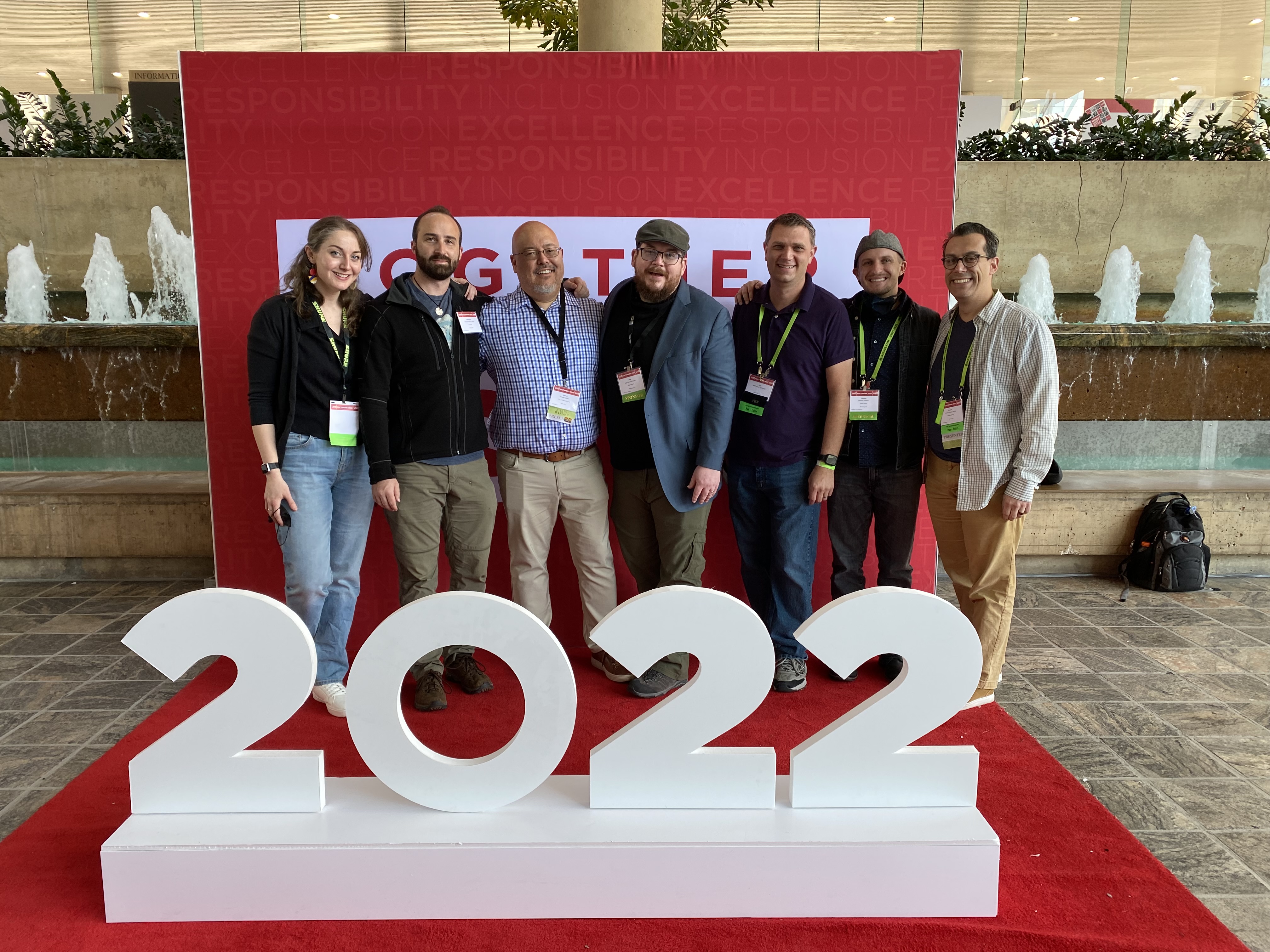
Students, faculty, staff, and alumni at USITT's 2022 conference.

A student mixes on L-ISA at L'Acoustics' North American HQ.


Tuesday, July 19, 2022

Jeff Polunas to leave UCI Sound

We were disappointed today to learn that Jeff Polunas, our Sound Supervisor for the past 4+ years, will be leaving UCI early next month to take an Assistant Professorship at Kent State University, where he'll be teaching sound design and projections.

Jeff has an MFA from UCI in Sound Design, and he came back to work as the Sound Supervisor from a teaching position at CalState Fullerton.  In addition to his work at UCI's School of the Arts, serving Drama, Dance, and Music productions, he also maintains an active freelance career, designing shows around the southern California area. 

At UCI, Jeff's work as the Sound Supervisor meant that he also always worked closely with the MFA Sound Design students, supplementing their coursework and design work with a strong technical foundation and skillsets.  He truly was a partner to Mike and I in the sound design program, and he leaves big shoes for us to fill.

We all wish him the best as he heads to Ohio for his new position.  Kent State is lucky to be getting him!

Tuesday, April 19, 2022

BOURN KIND- Tiny Kindness Project to premiere at Tribeca Film Festival

It was hard keeping this news under wraps for the past few months, but I'm excited to announce that BOURN KIND- Tiny Kindness Project will premiere in June at the Tribeca Film Festival!


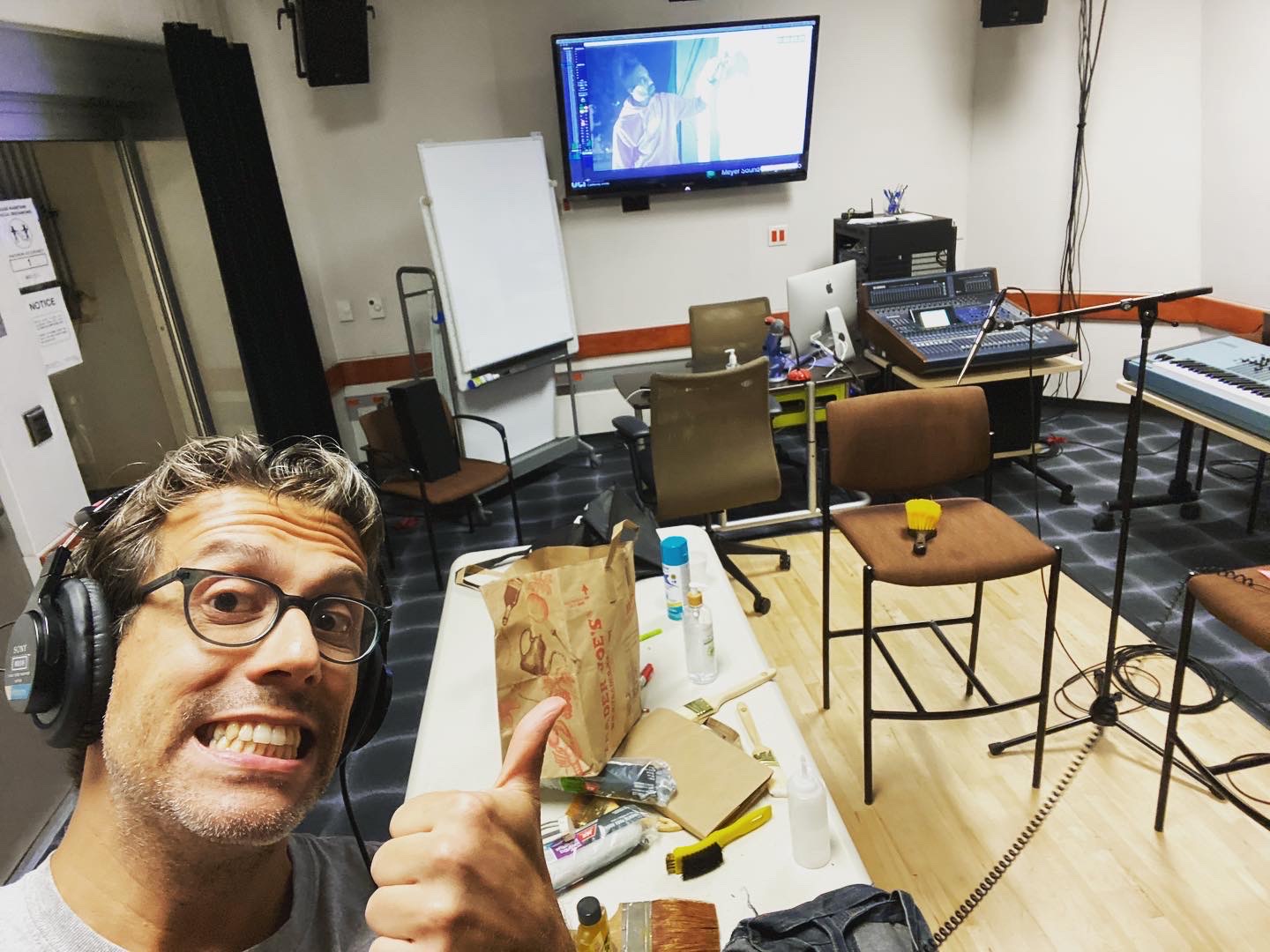
This is the second project that director Rachel Myers and I have worked on, and the post-production audio was done entirely in the Meyer Sound Design Studios here at UCI.  I did the foley performance, editing, mixing, and mastering, and MFA student Costa Daros worked as the foley mixer.  Here we are hard at work recording and mixing foley.


Congrats to everyone who made this beautiful film happen!  Check it out if you can!

Tuesday, April 12, 2022

UCI Sound Design: class of 2025

Recruiting students into the MFA Sound Design program is always tough for us.  We can only take two students each year, and there are always terrific students out there that we have to decline. This year was particularly difficult - the number of exceptional candidates was four times higher than it usually is, which made our decision much more difficult.

That said, Mike and I, along with the rest of the program are delighted to welcome our incoming students for this fall: Melanie Lopez and Jeremiah Turner.  Melanie and Jeremiah stood out to us with exceptional combinations of talent, creativity, curiosity, professionalism, and experience.  We're looking forward to working with them for the next three years!

I asked each of them to submit a short bio, so here they are, in their own words:


Monday, March 8, 2021

UCI Sound MFA, class of 2024

Every year when we interview potential MFA students for our Sound Design program, Mike and I always lament how hard it is to choose just two students from a qualified pool.  There are generally three or four students that are strong candidates, and it can be an excruciating decision to select which students to invite to join us for three years.  Part of selecting two students means necessarily saying 'no' to many more, including the few top-ranked alternates.  

This year was much harder, due mostly to COVID-19.  Because our industry is basically at a standstill, many folks are deciding that now is a good time to get their degree.  The number of qualified interested students shot up 500% this year. Instead of a pool of three or four top candidates, we had nine.  And, while in a normal year, we'd invite those three or four applicants to campus to sit in on classes, meet with faculty/staff/students, tour the facilities, and generally get to know us, this year UCI's campus is virtually shut down to outsiders.  So, we pivoted, scheduling Zoom sessions so that all nine top applicants could sit in on classes, meet with faculty, staff, students, get a portfolio review, etc.  It was a bit of a logistical nightmare and something I hope we don't have to repeat next year, but it gave us a chance to meet so many students that we'd never have gotten the chance to meet before. 

It also made our decisions harder, because while the number of excellent applicants increased, the number of people we could accept didn't.  We still had to choose two.  So while we're thrilled with the two women who are joining us this fall, we also want to publicly say that we wish we could have taken more of you!  Those applicants who are reading this - we wish you all the best and look forward to seeing your careers grow!

This year, Mike and I are thrilled to welcome to the UCI Sound Design MFA program two extraordinary designers.  I've asked them to write their own bios.  Here they are:

Tuesday, December 15, 2020

Track and Field 2020

 In my Trends in Modern Sound Design class, we often do an iterative hot-potato project called Track and Field.  It's an opportunity for the students to work on efficiency, conceptualization, and workflow. Here's how it works:


1) On the first day, each student brings in a 30-second piece of audio of their own creation.  The audio can be anything, from field recordings to original music to a short narrative. Students bring in both a rendered audio file and individual stems, and may spend no more than 60 minutes in the studio working on it.
2) Each submission gets passed to another student, then uses the original material as the starting point for their own work. Again, they must limit themselves to 60 minutes of studio time and 30 seconds in duration, but other than that, they can do anything they want. Students turn in both a rendered audio file and individual stems.
3) We repeat that over and over, with a matrix set up in such a way that each student usually gets to work on each thread.

This quarter, I had eleven students, so there are eleven threads.  I've taken each thread and strung each iteration together in sequence, so you can hear how one thread changes as different designers get their hands on the material.  Enjoy! 

(side note: Thread 7 featured some prominent commercial music, so SoundCloud won't let me present it to you.  Your loss!)

Tuesday, December 1, 2020

Teaching D-Mitri Remotely

Every fall, in our Digital Audio Systems class, I teach our first-year sound designers a two-week intensive overview on the Meyer Sound D-Mitri system.  D-Mitri is a powerful tool for live sound that combines the functions of a digital mixing console, a sound content playback device, a multi-channel sound spatialization tool, a room acoustics enhancement tool, and a show control hub all into one package.  D-Mitri systems are found in large scale sound installations around the world, from theme parks to Broadway to more.  The ubiquity and capabilities of D-Mitri are so large (as is the learning curve, frankly), that we typically have a number of second- and third-year students join us for the D-Mitri training to refresh their skills.

UCI has a small D-Mitri system, and we use it both as a teaching tool and in production.  When we teach with it, we roll the rack into the Meyer Sound Design Studio and patch eight D-Mitri outputs directly into our eight-channel loudspeaker system so that we can learn and work with it while experiencing its spatialization capabilities in real time.  D-Mitri programming happens through software called CueStation, which functions in a client-server capacity.  Multiple users can be logged into D-Mitri at the same time, each working on a different aspect of the programming.  Our D-Mitri classes typically involve everyone in the studio, sitting at their laptops, all wired into D-Mitri with a nest of ethernet cables.

The Meyer Sound Design Studio, in the before-times.


Of course, we can't do that this year.  We could have delayed the training module until we were able to meet safely, but I don't know when that will be, and I'm honestly tired of delaying things because of the freaking pandemic.  I didn't want to let the perfect be the enemy of the good, to paraphrase Voltaire.

So, in a pandemic, how do you teach a class that requires both client-server access AND the ability to perceive spatialized sound?  In order to solve this, I needed to think through a number of different challenges.  Here they are, how I thought through them, and how I eventually solved them.


Physical Locations

We knew that the D-Mitri rack would need to live in the Meyer Sound Design Studio.  The studio is currently cleared to be occupied by three people, but I was uncomfortable coming to campus for in-person class (I'm teaching all of my classes remotely this term).  Plus, I know how important the refresher is to our more senior students, and I didn't want to cut them out of the experience.  So, each student would be remote, logging in with their computers (with wired connections, preferably).  I came into the studio to teach the classes so that I could take care of any issues that came up while teaching that I couldn't deal with remotely.

Even though I'd be teaching from the studio, I expected that I'd need to be able to remote into the host computer in order to tweak details from home. Early in the quarter, while testing, I found that if I were on campus, I could screenshare with the host computer (an iMac that we call Chalkboard), but when I returned home, I couldn't screenshare with Chalkboard at all.  After consulting with our IT department, we determined that we needed a more robust screensharing tool.  We installed TeamViewer on Chalkboard so that I could control the host computer, restart failed connections, etc.  TeamViewer mostly worked like a champ, though there were a few times where I couldn't log on to Chalkboard at all. 


Connecting CueStation to D-Mitri

The easiest way to share a CueStation screen with the students was to just share my laptop's desktop via Zoom, but if I did that, they'd just be watching me click things, which is hardly useful when teaching a tool.  The students needed to be able to control CueStation on their own in order to get their (virtual) hands on the (virtual) machine.  I asked Richard Bugg with D-Mitri about how we might address this issue, and he noted that D-Mitri systems can be controlled from around the globe using a proxy server. The folks at D-Mitri use this feature to troubleshoot systems without having to fly halfway around the world, but it was just as useful for my needs.  Richard walked me through the steps to set it up and spent some time doing some testing with me. The proxy server required Chalkboard to be running CueStation, but as long as it was running CueStation and the proxy server was active, I could have up to eight clients logged in at the same time.  Sometimes it took a while to get all students onto the proxy server at the same time. The folks at Meyer use the proxy server to do maintenance on machines that are difficult to get to, not to teach D-Mitri to a class, so they don't typically have the user count that we did. 


Monitoring

So, we've figured out where everyone would be, and we figured out how everyone can control D-Mitri using a proxy server.  How can we send spatialized sound to the students so that they can all monitor the D-Mitri environment well?

My first thought was to build a SpaceMap (D-Mitri's spatialization tool) replica of the Meyer Sound Design Studio's loudspeaker configuration, take the eight outputs of D-Mitri into a DAW, place them into a 5.1 session, stream the six-channel output over the net, and then have students monitor with 5.1 headphones.  But, we ran into a number of challenges with this idea.  First, I couldn't find a reliable six-channel sample-accurate streaming tool.  We've been using AudioMovers, which does a great job with two-channel signals, but in testing, multiple two-channel instances did not sync to each other (there are rumors of a >2-channel upgrade, but I haven't tested it yet).  Also, six channels of audio is three times the bandwidth of two channels, which could impair networks in dorms and homes.  Finally, I was hoping to avoid having to seek out funds to buy enough 5.1 headphones to outfit the class.  So, back to the drawing board.

SpaceMap of the Meyer Sound Design Studio
A spacemap of the MSDS studio.


I solved my problem in the next iteration.  I still took the eight channels from D-Mitri in to my DAW, but instead of mixing to 5.1, I mixed to binaural.  I initially used Binauralizer by Noisemakers to render each D-Mitri input relative to the loudspeaker's position in the room, though I shifted to the dearVR Micro plug-in due to better low frequency management.  The DAW mixed all eight inputs together, and then I used AudioMovers to send a two-channel stream out to the students.  I cut the audio bandwidth by two-thirds and removed the need for 5.1 headphones!  

ProTools Session Set-Up
ProTools handled the binaural routing.


The eight iterations of NoiseMakers, positioned relative to their corresponding spatialization position.
Eight binauralization plug-ins spatialized the sound.


Ultimately, the students were able to listen to high-quality spatialized audio with a relatively low latency.  It wasn't the same as being in the room, but it was pretty close.


Returning to the Studio

We spent four two-hour sessions learning the basics (and some details) of D-Mitri remotely, and on the fifth and final day of the module, the two students and I met in person in the Meyer to review their work in person.  They had created a spatialized sonic event from their apartments, but they presented their work in person, through the eight-loudspeaker system that we have in the Meyer. This gave us an additional opportunity to discuss how well the binaural monitoring situation translated into actual meat-space monitoring.  Their work more or less translated well, but we note that monitoring a sound panned to the center of the room revealed itself differently in speakers than in headphones.  Via headphones, all eight ambisonic channels were being addressed, which imaged the sound to the center of our image. But in the studio, having all eight speakers firing didn't image to the center.  It either imaged EVERYWHERE (if you were sitting in the sweet spot in the room), or to whatever speaker you're closest to (if you're not in the sweet spot).  


Final Thoughts

You won't catch me yearning to do this again if I have the option to teach in person, but overall, I'm pleased with the results.  If I have to do this again, I'd need to address these issues:

  • Input source.  I was using a single channel of audio from ProTools as an input source.  I set ProTools to loop playback but sometimes the session would stop on its own.  Next time, I'd use a different, more reliable input source.  An FM radio would be a nice low-tech tool.
  • Remote Access via proxy server.  It wasn't as solid as I would have liked it to be.  In fact, on the first day of class, no one could connect except me.  
  • AudioMovers wasn't designed to stream audio 24/7 for 3 weeks, and it occasionally failed.  When that happened, I had to log into the computer, restart the transmission, and send the link around again.  I had to do that once a day or so.  Not a deal breaker.  Just a thing to note.

Overall, this was a huge success!  If you're thinking about doing something like this, let's talk!  I'd be happy to share my thoughts and brainstorm other/better solutions!

Saturday, April 18, 2020

Welcome to the Class of 2023!

So, we usually do this earlier in the academic year, but like everyone else on the planet, we got pre-occupied with Covid-19 response. Now that our 'new normal' is feeling settled, I'm able to get back to some of the things that weren't quite as pressing before.... which leads me to this:

Mike and I are proud to welcome our incoming first years students to the UCI Sound Design program: the class of 2023:

Costandina Daros is a soon-to-be graduate of Western Michigan University. Throughout her undergrad, she has worked on several productions in both the Theatre and Dance Departments, her favorites including Sound Design for Jesus Christ Superstar and Tribes. In her summers, she has worked at The Utah Festival Opera and Musical Theatre in Logan, Utah and The Stephen Foster Story in Bardstown, Kentucky. In her time at UCI, she is looking forward to exploring new ways of using sound to enhance storytelling.


Aerik Harbert hails from West Virginia by way of Maryland, where he currently works at Towson University. Before his job at Towson, Aerik worked at the Hangar Theatre and Baltimore Center Stage. He is a graduate of U. Maryland Baltimore County.


Wednesday, January 15, 2020

Field Recording, Crystal Cove State Beach


Last fall, I took the students in my Trends in Modern Sound Design class (all six MFA designers, and a few music PhD students) to Crystal Cove State Beach to do some field recording.  We divided the class into three groups: one group made b-format and spaced pair recordings, one group made co-incident pair stereo recordings, and one group made close-up mono and other recordings.  We talked about how to plan for a field recording trip, but each group of students had to plan, prep, pack, and carry their own gear.


We started out at the central section of the beach, where there are few cafes and lots of people. Some groups chose to wander far from the people to get some isolated sounds, but others chose to embrace the public and get some 'folks at the seaside' recordings.


After that, we packed up and drove the north edge of the park, which was virtually deserted except for a few seagulls.  We hoped to get some sounds of sea spray on rocks, but the surf was decidedly down that day.  Oh well.  At least we got a great sunset!


The student are now madly editing the sound effects and editing metadata.  Once that post-production process is complete, the sounds and metadata will be uploaded to our sound effects server so that the UCI Sound Design community can have access to it in perpetuity.  Once all that is done, I'll share some examples here!


Thursday, January 9, 2020

Track and Field 2019

In my Trends in Modern Sound Design class, we often do an iterative hot-potato project called Track and Field.  It's an opportunity for the students to work on efficiency, conceptualization, and workflow. Here's how it works:

1) On the first day, each student brings in a 30-second piece of audio of their own creation.  The audio can be anything, from field recordings to original music to a short narrative. Students bring in both a rendered audio file and individual stems, and may spend no more than 60 minutes in the studio working on it.
2) Each submission gets passed to another student, then uses the original material as the starting point for their own work. Again, they must limit themselves to 60 minutes of studio time and 30 seconds in duration, but other than that, they can do anything they want. Students turn in both a rendered audio file and individual stems.
3) We repeat that over and over, with a matrix set up in such a way that each student gets to work on each thread.

This quarter, I had nine students, so there are nine threads.  I've taken each thread and strung each iteration together in sequence, so you can hear how one thread changes as different designers get their hands on the material.  Enjoy!


Wednesday, December 12, 2018

Track and Field, 2018

In my Trends in Modern Sound Design class, we sometimes do an iterative hot-potato project called Track and Field.  It's an opportunity for the students to work on efficiency, conceptualization, and workflow. Here's how it works:

1) On the first day, each student brings in a 30-second piece of audio of their own creation.  The audio can be anything, from field recordings to original music to a short narrative. Students bring in both a rendered audio file and individual stems, and may spend no more than 60 minutes in the studio working on it.
2) Each submission gets passed to another student, then uses the original material as the starting point for their own work. Again, they must limit themselves to 60 minutes of studio time and 30 seconds in duration, but other than that, they can do anything they want. Students bring in both a rendered audio file and individual stems.
3) We repeat that over and over, with a matrix set up in such a way that each student gets to work on each thread.

This quarter, I had ten students, so there are ten threads.  I've taken each thread and strung each iteration together in sequence, so you can hear how one thread changes as different designers get their hands on the material.  Enjoy!


Tuesday, December 11, 2018

2018 Film Sound Projects

Every fall, all of the Sound Design MFA students take a course called Trends in Modern Sound Design.  The structure of the course is very loose, designed so that we can examine interesting avenues of sound design without having to stick to a strict course outline.

Over the past few years, one of the projects that I've done with the students is a film project.  The class is divided into groups, and each group is given two 60-second clips of film. One of the clips has more dialogue, and the other has more sound content.  The student groups are tasked with replacing all of the audio in the clips. This includes re-recording dialogue, recording and/or editing sounds, and creating and/or editing music.  It's a big project that takes most of the quarter, and while each group is responsible for their own final product, they help each other out with big foley sessions, dialogue sessions, and walla sessions.  Towards the end of the class, we watch the videos and engage in a discussion of the final work.

We don't spend a lot of time in class preparing for the project. We talked a little bit about spotting (ie identifying sonic events) and DAW organization for film projects, but this project really is designed to encourage the students to find their own solutions. And, when we review the final work, the conversation is generally more about the creative impact of their work than about the technical implementation.

Here are the videos from this year's project!  (and, I should note that I did not secure rights to use these film clips.  All the work was done for educational purposes only.  If you are or represent the rightsholder and want me to remove the clips, please let me know and I'll do so immediately).

Special thanks to the members and friends of the UCI Sound community who lent their voices to this project: Ezra Anisman, Jack Bueermann, Hailey Byerly, Toni Fajt, Garrett Gagnon, Joanna Hui, Caroline Jones, Joseph King, Hunter Long, Sophia Metcalf, Hunter Moody, Joaquin Palting, Malik Proctor, Andrew J. Tarr.


True Romance (UCI Sound replacement project) from Vincent Olivieri on Vimeo.
Triplets of Belleville (UCI Sound replacement project) from Vincent Olivieri on Vimeo.
Hacksaw Ridge (UCI Sound replacement project) from Vincent Olivieri on Vimeo.
Get Out (UCI Sound replacement project) from Vincent Olivieri on Vimeo.
The Conversation (UCI Sound replacement project) from Vincent Olivieri on Vimeo.
Arrival (UCI Sound replacement project) from Vincent Olivieri on Vimeo.

Tuesday, June 12, 2018

Sound Art: final projects

This term, I taught a class in Sound Art.  The course itself lent itself to self-direction. Each week, students would read for an hour or two on a sound art-related topic of their choosing.  When the class met, we would incorporate their readings into the discussion.  Our topics ran broad, from the definition of sound art, to social responsibilities (or lack thereof) of artists, to the role of virtuosity in artmaking, to the technical tools for implementation of sound art.

Additionally, students worked on three projects, the last of which was a sound art piece of their own creation.  Last week, the students presented their final work.  I won't go into the details of the pieces, except to say that they had a huge range.  One student created a balloon-festooned sound walk. One placed contact microphones on a campus bridge and used the inputs to create new content. One created an interactive sculpture using mirrored cubes, hyperdirectional loudspeakers, and QR codes.  The pieces were varied and very interesting.  Here are some photos!


Monday, April 2, 2018

Meet our new Sound Supervisor… Jeff Polunas!

After an extensive search, we are thrilled to announce that Jeff Polunas will be joining UCI mid-May as our new Production Sound Supervisor!


Jeff is thrilled to be retuning to UCI, where he received his MFA in Sound Design in 2012. Since graduating, Jeff previously served as Production Sound Supervisor at CSU-Fullerton for 5 years. Jeff is also a member of USA829 as a Sound Designer and has recently designed Shakespeare in Love and Sisters Rosensweig at South Coast Repertory. With over 125 designs to his credit, he has designed for the following theaters: South Coast Repertory, Antaeus, International City Theater, PCPA Theaterfest, Summer Repertory Theater, Atwater Village and many universities in Southern California. Jeff is also a member of the USITT MainStage Committee which he helps organize, install and run the Sound element of the MainStage events each year. Jeff is looking forward to working with the Graduate Students at UCI and helping mold future sound designers.


It's been a very long year since we lost our dear friend and longtime Sound Supervisor, BC Keller.  I would like to personally thank the following people for doing double-duty getting our shows up and keeping the shop from exploding:  our "unofficial" interim supervisors -- Kate Fechtig, Matt Glenn and Mark Caspary; our incredible grads -- Jordan Tani, Andrew Tarr, Ningru Guo, Hunter Moody, Jack Bueermann, Ben Scheff and Andrea Allmond; our Production Manager -- Keith Bangs; and the over-hire professionals from Diablo Sound.  You are all the very best, but thank goodness Jeff is on the way… and not a minute too soon!

-Mike Hooker

Thursday, March 29, 2018

Meet our incoming students!

We had a terrific group of applicants this year apply to the sound design MFA program, and it was a tough decision to choose which two we'd invite into the program. But, Mike and I are excited to introduce the class of 2021 at UCI Sound! Elisheva and Garrett are both remarkable artists, and we're looking forward to having them join us for three years of intense development.  Stay tuned for great things from them!


Elisheva Anisman recently graduated from Western Washington University where she studied theater, audio recording, and storytelling, in addition to sound designing a plethora of productions. She is passionate about how and why stories get told and how sound can help communicate a narrative. Since graduating she has worked as a sound designer or engineer for a variety of local companies in northwest Washington and has experimented with performing her own music.


Garrett Gagnon is incredibly excited to be joining the Sound Design program at UCI! He has lived in the Southwest Michigan area his whole life, and can’t wait to make the trek to the West Coast. He has been a musician (vocal, piano, drums) his whole life, and has always been able to find work that pulls from his strengths. He has worked at two different recording studios, and engineered live and studio albums in various genres, primarily focusing in jazz and classical. Garrett has also built a relationship with many theatres and schools in the area, and has been resident Sound Designer at Farmers Alley Theatre for the past few years. He cannot wait to start exploring what he can bring to the Sound Design program at UCI!