
The Claire rep system includes two 8-cabinet M1D arrays framing the proscenium, as well as an arrayed pair of UPQ-1Ps as a center cluster. In addition, we added three UPM-1Ps in the catwalk to use as delay fills and six MM-4XPs for front fills. SIM3 served as our analysis platform, and we kept a few UP-Juniors, UPJ-1Ps, and UP-4XPs as backups for playback or if we wanted to integrate them into our system. Meyer's D-Mitri system, in combination with a 32- and a 16-fader Cue Console, served as the primary mixing console and matrix. UCI's Galileo 616s and 408s were used for loudspeaker processing.
Day 1 of the seminar was spent listening to and tuning this system. Tony's techniques brought a fresh perspective on the tuning workflow, and it was a good reminder that everyone has a slightly different approach when it comes to tuning a complex system. In a couple of instances, it was necessary to reconfigure the patching between the system and SIM so that SIM could compare the microphone feeds with an appropriate junction in this signal chain. It was a fascinating process to participate in.
 |
| Day 2: The class walks the room evaluating the system tuning. |
 |
| Day 2: Tony Meola describes his approach to musical sound systems. |
Day 2 was focused primarily on mixing. As mixing material, Tony was kind enough to procure a stemmed version of the original cast recording of "Defying Gravity" from Stephen Schwartz. We split up into groups of two, one
person mixing vocals and the other mixing the orchestra. Afterward, Tony would give us notes we we'd get another go. After a quick lunch break, we resumed our mixing—but this time, we were going solo (with a little help from Tony). Again, we'd receive notes, but this time the notes came from our peers.
It was a tremendous opportunity for all involved. Our reactions were so personal that we thought it would be fitting for each of us to write about our individual experiences:
Mixing “Defying Gravity” with Tony critiquing us was such a rush, even if it may not look like it from the photos—apparently when we are both panicked it translates into blank expressions but I promise it was terrifyingly fun. It was an interesting experience mixing a song with another person and it was an excellent lesson in making sure to not only critically listen to how I was mixing but how my mix consequently affected Stephen’s mix, and how we could work better together.
It was a tremendous opportunity for all involved. Our reactions were so personal that we thought it would be fitting for each of us to write about our individual experiences:
Mixing “Defying Gravity” with Tony critiquing us was such a rush, even if it may not look like it from the photos—apparently when we are both panicked it translates into blank expressions but I promise it was terrifyingly fun. It was an interesting experience mixing a song with another person and it was an excellent lesson in making sure to not only critically listen to how I was mixing but how my mix consequently affected Stephen’s mix, and how we could work better together.

Day 2: Stephen Swift and Patricia Cardona mix "Defying Gravity" from Wicked.
I also had fun during our load-in day, Richard taught me how
to update the firmware on the D-Mitri and get it configured for the seminar. I
also learned how to network the CueConsole modules into the D-Mitri frames and
Richard taught me lots of useful features of CueStation 5.5.1 while we were
setting up. I could have easily spent
the whole day with him learning more about good practices and tips/tricks to
use when using D-Mitri in a live setting, since most of our experiences using
D-Mitri at UCI have been primarily for playback.
-Patricia
 |
| Day 1: Richard Bugg and Patricia Cardona setting up D-Mitri. |
-Brian
 |
| Day 3: Tony Meola gives mixing notes to Brian Svoboda & Mark Caspary. |
I am so thankful for such an amazing
opportunity. The seminar was fantastic. It was unlike any we have had here at
UCI. We learned an incredible amount in the three days with Tony and Meyer
Sound. Tony spoke about the importance of collaboration in theatre. That
collaboration was apparent in the way he worked with us. It was a thrill to
watch Tony optimize a Broadway size system from the ground up. Working with
Steve Bush, Richard Bugg, and Gavin Canaan from Meyer was icing on the cake. I
mastered some new Galileo tips and tricks thanks to Steve Bush. (hint: modifier
keys). I am especially appreciative of Steve Bush’s uncanny ability to
explain the science of sound in a way that just makes sense. The seminar was
amazing and I am so thankful for Tony, Meyer Sound, Steve, Richard, Gavin,
Mike, Vinnie, and B.C for providing us with this amazing opportunity. Thank you
all.
- Josh
 |
| Day 3: Marking up our scripts for "Defying Gravity" from Wicked. |
This seminar was thrilling, not only to practice under the eyes and ears of Tony but also to learn from and problem solve with Steve, Richard, and Gavin. It was humbling to experience the musical connection that a mixer has to the performance. I come from a music performance and studio engineering background, and to hear the console referred to as a kind of "instrument" is very vindicating. And I must mention the valuable tricks that I picked up regarding SIM—our mid-seminar reconfiguration of SIM/D-Mitri was a quite helpful.
Very rarely has mixing been such a directly collaborative effort for me. Of course the mixer is constantly collaborating with the performers, but I have never had a chance to play "mixer four-hands". It was an awesome lesson, not only in critical listening but in subtle psychology—gestures that I would make would affect Josh's arc and vice-versa. I have an increased amount of respect for those who can master that dance.
Very rarely has mixing been such a directly collaborative effort for me. Of course the mixer is constantly collaborating with the performers, but I have never had a chance to play "mixer four-hands". It was an awesome lesson, not only in critical listening but in subtle psychology—gestures that I would make would affect Josh's arc and vice-versa. I have an increased amount of respect for those who can master that dance.
I have to thank Tony, Steve, Richard, and Gavin for trusting us enough (artistically and technically) to say to us "here ya go...show us what you've got". Tony: the ability to mix the tracks from Wicked was emotionally thrilling, and your guidance has refocused the way I think about dynamics in music for theater. Team Meyer: every time you let me sit in the hot seat with one of your systems I come out a better listener and designer.
It's the best way to learn, and you all rock at teaching it!
- Matt
 |
| Day 3: Matt Glenn & Josh Fehrmann mix "Defying Gravity" from Wicked. |
Having Tony Meola come to UCI was an amazing experience. The insight he was able to give on mixing, and his method of thinking about sound was really interesting, and gave us a new perspective. The amount of experience and detail of descriptions was intense, like for example the difficulty of hiding lavalieres in film grade wigs versus theater grade wigs. Being able to mix wicked, even for an empty stage, was definitely the highlight for me, and getting critiqued by my peers and Tony Meola was pretty exciting too! I’m glad UCI was able to make this sort of thing available for students here.
-Elliot
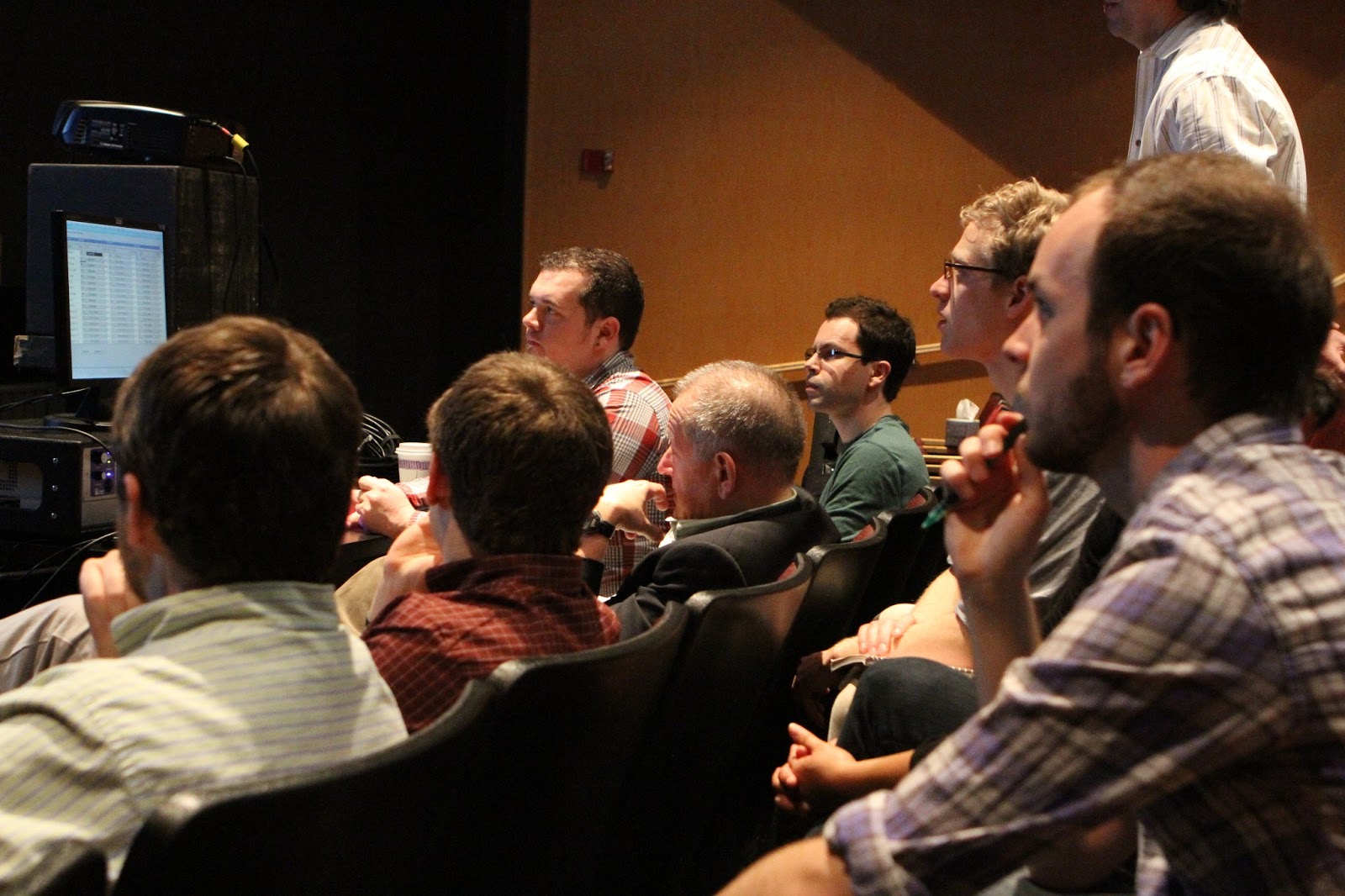 |
| Day 2: Josh Fehrmann drives SIM3 for part of system tuning. |
My recent experience with Tony Meola and the crew from Meyer sound was a graduate student sound designers dream. Ever since Wicked came out I was stunned by the quality of the sound design. I have seen the musical twice during its first run in Chicago and we had the CD. My whole family loved the musical! As a high schooler I dreamed of mixing that show or a show of similar quality and musicality. To hear the individual tracks of Wicked was stunning. To hear individual tracks of Idina Menzel and Kristin Chenoweth singing and to be able to mix the show while being given guidance was the finest example of a master class that I could imagine. A master class with Tony was a fantasy come true for me as well all the other graduate sound designers and I believe even for the sound design faculty. It was also a great learning experience to watch the way Tony tuned our space and the Meyer specialists work their systems and handle gear. There was a great deal of very useful shared verbal information that will clearly shape the way I approach my work in the future.
-Mark
 |
| Day 2: "Where are you sourcing the image now?" |
Although it’s been a few weeks since the seminar happened, I still find myself back in the moment: in the hot seat, performing on the CueConsole mixer. Mixing is such a thrill; shaping a piece is such an intimate connection to music, very akin to playing a musical instrument live. I never had imagined myself mixing a Broadway cast recording in front of a renowned sound designer like Tony Meloa, and it was a wonderfully humbling unique experience. It reaffirmed, yet again, why I had applied to grad school. Three years ago I didn’t really know what to expect; I had hoped I would be part of a group that is curious, experiments, shares knowledge, and tackles interesting projects together. These seminars—that Meyer Sound so generously makes available—are times when I think we’re pushed to our best working together.
 |
| Day 2: The class experiments with delay and level shading. |
I’d like to thank Mike, Vinnie, BC, Helen, Steve, Gavin, Richard, and of course Tony for making this mixing seminar possible. From the insight into Tony’s philosophical approach to sound design, to the rush I felt when Patricia & I hit our collective groove mixing Defying Gravity together... these moments will be forever inspiring. –Stephen
 |
| Day 3: Meyer Sound Mixing Seminar at UC Irvine Class Photo — March, 2013 |
 |
| Day 3: Post seminar family dinner. |


